Pages

Showing posts with label review. Show all posts

Tuesday, 31 July 2012

Insignificant Gestures ~ Jo Cannon

The best thing about helping with the Edge Hill Prize was discovering brilliant writers, many of whom were published by small, independent publishers with little or no budget for publicity. One of my favourite longlisted collections was Jo Cannon's 'Insignificant Gestures.' I reviewed it in 2011 here, but I recently reread the collection and have written a longer review:

Jo Cannon is a GP in an inner city practice and her medical expertise is brought to bear in many of the stories in this entertaining and readable collection. Her writing is moving but decidedly unsentimental. The collection begins quietly with the title story 'Insignificant Gestures.' The doctor narrator has returned from Malawi and retrained as a psychiatrist so that he will never have to 'smell blood again, or the sweet nail varnish odour of starvation.' His experiences in Malawi have left him dependent on medication that makes his fingers tremble, but he confesses that he would 'take anything not to wake a three in the morning with my thoughts crawling round and round like caterpillars along the rim of a glass, endlessly circling the same regrets.' Some of those regrets are explored as the doctor remembers a fatal misdiagnosis which left him unable to sleep and feeling 'all edge and scalded surface.' In the closing scene the doctor's memories tumble out, 'like opening an overhead locker.' As he talks about Malawi to a nurse he watches her chewing on her thumb and notes, 'Beginnings start like this, with insignificant gestures.' It's a carefully observed, restrained story that explores degrees of helplessness and sets the tone for the rest of the collection: watch out for the details in these stories, observe the minutiae, the seemingly insignificant gestures, this opening story seems to say.

Medics appear in many of the stories. A doctor’s tact and kindness lead to a moment of acceptance in the sad and funny ‘New Look.’ In ‘Rictus’ a bereaved woman is assailed by memories of medical interactions after her dog dies, while a nurse’s recommendation of speed dating in ‘The Alphabet Diet’ allows Mick to finally acknowledge, ‘how hard it is to tell the truth, to open drawers and show the broken things inside.’

One measure of a successful collection is the memorability of the stories; how many of them stick with the reader and niggle long after the book's pages are closed? 'Insignificant Gestures' is packed with stories that resonate. ‘Fairy Story’ examines a mother’s feelings of culpability when her daughter is hospitalised for anorexia, but it’s not a story without hope. ‘There’s always a way back,’ she tells her daughter. ‘The good and courageous will prevail. And if you are lost, sooner or later someone you love will come and find you.’ 'Daddy's Girl', a story in which a young man boards the tube carrying a rucksack, is an intricate exploration of secret thoughts and isolation. Jo Cannon achieves a lot in very few words and the story ends with a revelation of what is to come: ‘A little girl won’t go to school. Police cars and TV crews will come in the night. Her friend’s fear will be the first crack. Aftershocks from the explosion will injure all the days of her life.’ In 'Mercy is Sick Today' a girl embraces her prodigal sister: 'Flicking at flies, shooing curious children, I guard her. At midday I light the fire for nsima. Not everyone in the village will eat today.' 

Other particularly memorable stories include the sinister 'Shutters' in which the narrator says to his wife, 'Now you're ill it's better. There's only me.' 'A Good Match' is an intricate examination of cultural differences in an arranged marriage, while Dr Campbell is visited by a ghost from her past in 'The Spaces Between' and in 'Staying Power' a woman takes a stand: 'I tear him out like wrapping paper: pinch the edges and pull. So easy I could have done it any time.'

Zoe King maintains that to read Jo Cannon is to 'enter the world of the displaced, the dispossessed, and to emerge with a new understanding,' and Vanessa Gebbie writes that 'Insignificant Gestures' is full of stories that 'sing long after the reader has put down the work.' I felt sad when I reached the end of this collection because I wanted to keep reading. If Jo Cannon produces another collection it will go straight on my wishlist.

Sunday, 13 May 2012

The Birth Machine ~ Elizabeth Baines

Tucked up on the ward and secure in the latest technology, Zelda is about to give birth to her baby. But things don’t go to plan, and as her labour progresses and the drugs take over, Zelda enters a surreal world. Here, past and present become confused and blend with fairytale and myth. Old secrets surface and finally give birth to disturbing revelations in the present. 

Originally published in the eighties, The Birth Machine was seized on by readers as giving voice to a female experience absent from fiction until then. It was acclaimed as a significant event in women’s publishing and quickly became a classic text. Out of print for some years, The Birth Machine is now reissued in a revised version (which first appeared in 1996). Still very relevant today to modern Obstetrics and Medicine, The Birth Machine is however more than that: it is also a gripping story of buried secrets and a long-ago murder, and of present-day betrayals. Above all, it is a powerful novel about the ways we can wield control through logic and language, and about the battle over who owns the right to knowledge and to tell the stories of who we are. The book was dramatised for Radio 4 and starred Barbara Marten as Zelda.


As I began to organise my response to this book I realised something; I don't like thinking about childbirth: I avoid TV programs about it, I've never been present while anyone (except for myself) has given birth, I’ve never written a birth scene and I’ve never tried to describe labour to a first-time mum because I think it’s hard to strike a balance between honesty and kindness - something a woman in my first ever antenatal class illustrated when she claimed that during a previous labour, she’d been butchered from ‘top to bottom’ and had needed thirty stitches (the midwife later assured me that the woman was lying as no-one counts the stitches because they’re done in layers, depending on the depth of the tears, which of course made me feel much better...).

Occasionally, one of my children asks me to tell them the 'story' of their birth. My response is mostly fairy tale, mixed with a few factual details re. the date, time and method of delivery etc. Such an account combines magic and science, but a more honest reflection would probably result in something that is part fairy tale, part horror story and in many ways I think The Birth Machine is such a narrative.


The Birth Machine is a fascinating read. In the Author's Note, Baines reveals that the structure of the novel is intended to:

'ween the reader (and in particular the unwilling or squeamish reader) gradually from the safety of 'objectivity,' via a growing familiarity with Zelda through her memories, to the shock of her subjectivity - though even then her experience is presented as flashback, in third-person past tense: Zelda herself, leave alone the reader, can only contemplate it at a distance.'
Baines achieves her aim. The Birth Machine is uncomfortable and claustrophobic, the first novel in a long while to make me feel both disquieted and queasy. In the opening scenes, the reader is invited to observe Zelda - 'the patient' - as she is connected to 'the machine'. 
'Good morning Mrs Harris. Mrs Harris is about to benefit from our modern technology. Aren't we, Mrs Harris?' He says with a wink in Mrs Harris's direction: 'Mrs Harris is a rather special patient. How are we feeling, Mrs Harris?'
The Professor's words set the tone for Zelda's interactions with medical staff throughout the novel. She is repeatedly patronised: ‘Naughty girl, now, Mrs Harris,’ 'Mrs Harris! What on earth are you doing out of bed,' 'How are we doing Mrs Harris?' The reader initially sees Zelda through the eyes of the Professor and his students. Baines writes that 'the whole is undercut by satire, and a questioning of the authority of the professor [is] thus prompted.' While this is certainly the case, the medical professionals also make the hospital scenes confining and distressing as their powerful, infantilising voices serve to propel Zelda again and again into childhood memories. The dream-like quality of these and other memories blend with myth and fairy-tale to further distance the reader and evoke feelings of powerlessness and disorientation.

During moments of greater lucidity, Zelda attempts to look beyond the haze of pain to uncover the reasons for her induction. She wonders if she is at fault: 'bad veins, bad placenta, inadequate mother,' 'She got too fat, and she deliberately slimmed again. She distorted the chart.' Throughout the novel Zelda has no say in what happens to her body - she isn't even allowed to go to the toilet: 'No getting out of bed once your waters have been broken.' Following delivery, Zelda's baby is removed: 'The baby is gone. They have taken it away. And she hasn't even touched it.' Even the hospital notes are, 'Not her notes at all, whatever she calls them. Hospital property. Private information.' Her lack of autonomy and control ensure that the discovery of the reason for her induction is a triumphant moment - knowledge is power and once Zelda is in possession of this particular knowledge she finds herself at last able to 'acknowledge her own insights, to be her own author.'

Lisa Glass makes the following observation in her excellent review (link below) 'I was in awe of the masterful examination of polite cowardice and of the barriers constructed to prevent women from asking questions about their own bodies.' I too found the masterful examination of 'polite cowardice' compelling, but I was also impressed by the way this novel weaves and twists; the way in which the disorienting world of pain allows secrets from the past to meld with imagination and, at times, hallucination to create a disturbing and thought-provoking meditation on power, control and the uncertain language of logic.    

Read excellent reviews of The Birth Machine here and here.

Sunday, 29 April 2012

Chameleon ~ Beda Higgins

Chameleon-120Chameleon is a lovely collection of beautifully written, sad and funny stories. The opening story 'Haunted' is an authentically imagined story about friendship. Ten year old Kirsty's jealousy is palpable and it leads her to do something terrible. 'The Quiet Man' is a satisfyingly wicked look at hidden depths and the resentment that builds when a new wife steals every moment of her husband's peace. In 'True Love' it is the old man Jim, and not the young narrator who understands what love is. 'Poor Clare' is an emotionally charged story about first love, transgression and the hope of absolution. There are supernatural and fairy tale elements in many of these satisfying and well-written stories. Beda Higgins's story 'Wiggy' won the 2009 Mslexia competition.

Read a review here.
Visit Beda's website here.

Saturday, 28 April 2012

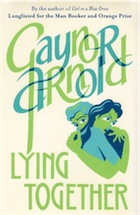
Lying Together ~ Gaynor Arnold

These short stories are so packed with life that each could easily stretch into a novel. Set during the Second World War, 'Looking for Leslie Howard' sees waitress Elsie discovering that a beautiful young man she admires is a conscientious objector. Arnold's writing is seamless and the characters are compelling: I would happily read the novel 'Looking for Leslie Howard' (if such a book existed). Each story in this collection is meticulously situated, from the modern day setting of 'Telling Radnor' to the reexamination of the past in 'Angel Child' the reader is instantly immersed in the beautifully constructed world of the story. The title story 'Lying Together' sees Glenys trying to get her 'thoughts straight through the mist' as she spends a fortnight with Bill. 'Taking People In' offers a glimpse into another world and the aforementioned 'Angel Child' contrasts beautifully with its predecessor 'Mouth.' The stories in this collection have been described as 'full of humanity but entirely without sentimentality.'

Read a review here and here.
Read interviews with Gaynor Arnold here and here.

Friday, 27 April 2012

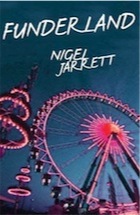
Funderland ~ Nigel Jarrett

The title story of this collection is not for anyone who is nervous at the fairground. 'Funderland' sees Dale recalling a roller coaster accident with devastating clarity. He remembers how the car 'became wedged, somehow pinned by gravity into a corner from where he could see Johnny and Rose plummeting like rag dolls to their deaths.' It's a striking opening to a sensitive and revealing collection. In 'A Point of Dishonour' the narrator visits a writer, Kramer, who has written a book about soldiers that were court-martialled and shot in the Great War. The narrator's grandfather features in the book and she brings with her a newspaper clipping that shows her grandfather in a new and disturbing light. It is a subtle story in which what isn't said is important. Kramer hands the newspaper clipping back and becomes kurt, '...as if I had deliberately tried to embarrass him, and he twice looked at his watch without saying anything about soon having to attend to something else.' In 'Ornithology' depression is linked to the disappearance of birds as a woman misses their 'madness in the air.' Jarrett's writing is varied and musical.

Read a review of Funderland here.
Read an interview with Nigel Jarrett here.

Thursday, 26 April 2012

Listen Close to Me ~ Catherine Eisner


Eisner's collection is subtitled, Hidden Lives of Love, Madness, Murder, Loss and Deception, and while the sense of madness and loss is amplified by the book's extraordinary and disturbing cover, there is also a tremendous sense of fun here. Eisner makes use of intriguing subheadings and 'source material' such as newspaper clippings, graphs, poetry, diary pages and extracts from old school books. There are just five stories in this 228 page collection and these are followed by a series of graphological notes on the handwriting of various characters. 'Lovesong in Invisible Ink' is a digressive and knowing narrative that spans decades. The narrator is self-deprecating and likable; there's no Reader, I married him here, it's 'reader, I slept with him.' The title story is the last testament of its asexual narrator. It's a odd story, full of strange characters and erotic imagery: the narrator's husband refers to her as his 'long noodle,' and poor Uncle Irving's body has to be identified by dental records - all that is left of him is his toupee. The stories in this collection are dark and the characters are 'driven by bizarre and sometimes criminal compulsions.'

Read an interview with Catherine Eisner here.
Catherine Eisner's blog.

Wednesday, 25 April 2012

Saints and Sinners ~ Edna O'Brien

Saints and Sinners book coverThis collection of eleven stories won the Frank O'Connor Award. It's a collection that's packed full of 'the sad and the stranded, the hopeful and the lovelorn'. In 'Shovel Kings' Rafferty reminisces about coming over to England as a boy. When he is offered a chance to return to Ireland, he can't contain his joy, but he quickly discovers that although nothing is wrong at home, nothing is right either. In 'Sinners' embittered guest house owner Delia, a woman who likes to be 'always in the right,' regards a visiting family with suspicion and in 'Madame Cassandra' O'Brien provides the reader with an opportunity to read the thoughts of a lonely wife. These stories are full of hurt, yet they are also measured and lyrical. Man Booker International Prize winner Alice Munro maintains that, 'Edna O'Brien writes the most beautiful, aching stories of any writer, anywhere.'

Read about O'Brien and listen to story extracts here.
Read a review here and here.

Tuesday, 24 April 2012

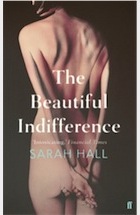
The Beautiful Indifference ~ Sarah Hall

Hall's short stories have been described as 'satisfying and intriguingly open-ended, haunting the imagination long after the last page is turned.' The opening story in this collection, 'Butcher's Perfume,' is beautifully written in a curious mix of slang and dialect: Manda is fierce, but she isn't 'pelvic, or thick with glands and brawn' and her father is 'gristle right through to the bone,' while the passages to the city are a 'burnt-farm, red-river, raping territory. A landscape of torn skirts and hacked throats... and haylofts used to kipper children.' The story ends with an act of retributory violence which the narrator, Kathleen finds unsettling: 'I searched her face for some sign of disturbance and saw nothing favourable. Her eyes were that glisky blue, all bad charm and cheek.' In 'The Bees' the narrator muses about the past as she observes the mysterious deaths of bees in a London garden, while the Scandinavian landscape is remote and striking in 'Vuotjarvi'. The stories in this collection are accomplished and assured, and the language is always startling. As Clare Wigfall writes, 'These stories are dark, raw and heartbreaking. An immensely satisfying collection.'

Read a review here and here.
Find Sarah Hall's website here.

Monday, 23 April 2012

Pictures From Hopper ~ Neil Campbell


This collection of short stories draws on the work of American painter Edward Hopper. The stories are short and full of life - adultery, marriage, alcoholism, violence and humour. It's hard to resist the urge to find the paintings that correspond (or partially correspond) with the story titles and 'read' them together (I didn't resist the urge - I went with it and very much enjoyed myself). Campbell's stories are deftly executed snapshots of life. 'Sun on Prospect Street' takes a beautifully visualised and unsentimental look at friendship as the reader follows Leo and Joe past the glue factory, the railway, the canal and onto the playing fields where their football skills and loyalty are tested. 'Piccadilly Gardens' is a bleak, carefully observed story about loneliness, secrets and petty cruelties inflicted by people who have no hope, while 'Vigilante Man' is a compelling monologue from a father: 'I'm a rational man. I just wanted to protect my family.' In very few words, Campbell creates a real sense of place and space. Even the shortest of these stories benefit from his 'understated but penetrating vision'.

Read an interview with Neil Campbell here.
Read 'Cars and Rock's here.
Read a sample of the collection here.

Sunday, 22 April 2012

Starlings ~ Erinna Mettler

Starlings, described as a 'daisy-chain novel,' offers the reader an almost bird's eye view of Brighton, sweeping and swooping from story to story, character to character. The opening story 'The View to the West Pier' races towards an deeply disturbing climax as Andy, a recently released paedophile, encounters siblings Oscar and Arabella at the park. 'Pebble-dashed' is a story about secrets and seeing, as photographer Alistair fails to notice what's right under his nose. In 'Editor' Louise, Jerry's beautiful neighbour becomes the most important person in his life, while 'Snip' is a story about a fateful train journey that takes place the night before Drew's vasectomy. Mettler writes well, her prose is fluent and compelling, and this collection of linked stories is a fascinating exploration of city life.

Visit Erinna Mettler's website here.
Read a review of Starlings here.
Read 'Underneath' here.

Saturday, 21 April 2012

Household Worms ~ Stanley Donwood

Household WormsThere is something old-fashioned about this beautiful little book - the creamy paper, the soft, corrugated cover - it's a book that needs to be touched. The cover illustration is perfect for the slightly odd, surreal and out of kilter narratives that characterise the collection. There are forty one stories, some are quite traditional in length and structure, others, like the two sentence 'Day Dream' are tiny. The opening story 'Wage Packet' is a desperate, yet hilarious account of working in a restaurant kitchen manning the waste disposal machine, affectionately known as The Pig. Many of the stories are fragmentary; 'Lachrymose' contains a recipe for Tear Wine. An unusual alternative to football is proffered in 'Sky Sports,' while 'Romance' takes the form of an overheard conversation. There is also a tremendous sense of fun in this collection - as is seen on page 94 which contains just five words: 'Nothing seemed to be happening.'

Read a review here.
Read an interview with Donwood here.

Friday, 20 April 2012

Everyone's Just So, So Special ~ Robert Shearman

The stories in this unique collection are linked by a crazy and entertaining historical rant (which may require a magnifying glass to read). It often feels as if the history/timeline and the italicized story which is nestled within it is an elaborate joke (I'm pretty sure that it is), but then a particularly searing observation or unnerving comment will illustrate something about the desire we all have to be remembered, to be special, and the reader is suddenly wrong-footed into contemplation. Notable stories are 'Cold Snap,' a frightening and funny take on Santa, 'Restoration,' a beautiful and inventive story about history and memory, 'Without You, I Wouldn't Be Alive' guaranteed to make book lovers' hearts sing, 'Endangered Species,' and 'Acronyms' which I promise will make you crave a BLT made in exactly the way described. It's hard to capture the work of a writer whose stories are 'as light as souffles and nourishing as steak' (Jack Dann) but I attempted it in a longer review which I wrote last year.

Watch Rob reading at the launch.
Read a review here.
Read Rob's most recent work here. 

Thursday, 19 April 2012

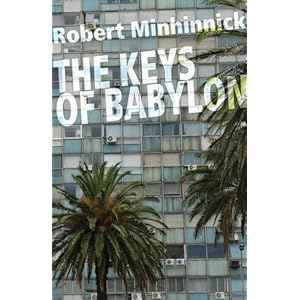
The Keys of Babylon ~ Robert Minhinnick

The Keys of BabylonSet in China, Wales, the U.S, Albania, Mexico and London, this collection of linked stories explores migration. The collection is divided into two sections, the first shows characters searching for better lives, the second revisits the characters on the 13th August allowing the reader to discover what has happened to them. The first story 'At a Dictator's Grave' follows Mic from Albania to Kings Cross - 'the centre of the world' - where he remembers his past in the Champagne Bar at St. Pancras Station with a prostitute, Li. Later, in the second half of the book the reader revisits Mic in his hostel to see him looking for Li while in terrible danger during the night. 'In Those Days There Were Lions in Iraq' introduces the reader to disenfranchised environmental campaigner, Mascen whose acquaintance, Mohammed, reveals how he was able to 'rescue' various items from a Baghdad Museum and use the proceeds to build a new life in Poole, Dorset. The return to Mascen's story is more hopeful than Mic's but it is still laced with sadness. It's hard to do justice to almost three hundred pages of meticulously researched, exquisitely written prose in a couple of hundred words.

Read a review of the collection here.
Read about Minhinnick's work here.

Wednesday, 18 April 2012

Smoked Meat ~ Rowena Macdonald

This collection has been described as, 'Deliciously erotic and hugely readable, with some wonderful moments of illumination.' Smoked Meat is set in Montreal and Macdonald takes the reader on a journey through the seedier side of the city, exploring the interlinked relationships and secrets of those who live there. The first story, 'Brian, McMurphy & Sally Too' tells the story of long time friends Brian and McMurphy who grew up in Gimli, 'a deadbeat town on the outskirts of Winnipeg where the biggest thrills were shooting up horse tranquilisers and playing chicken on the railroad track.' Their friendship is jeopardised when McMurphy falls in love with irritating life model, Sally. The reader recognises familiar characters as they continue to crop up in a variety of stories; 'Down to 'Rue Beaudry' tells the story of Henry who is unfaithful to his girlfriend with a man he meets in a sauna. The story is followed by 'Slow Burn' which offers neighbour child Esme's perspective on Henry's infidelity, and Henry's girlfriend Corinna's story is further explored in 'Double Take.' The exploration of character from differing viewpoints gives Macdonald's collection a real sense of place and community.

Read an interview with Rowena Macdonald here.
Read a review of Smoked Meat here.

Tuesday, 17 April 2012

This is the Quickest Way Down ~ Charles Christian


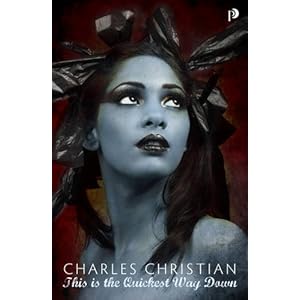
This is the Quickest Way Down (Proxima)This is the Quickest Way Down is a collection of dystopian, sci-fi, urban gothic and dark fantasy short fiction, as suggested by its striking cover. The opening story 'Waiting for my Mocha to Cool' is a fragmentary narrative, stuffed with pithy character descriptions and entertaining observations: 'the most clinical, obsessed, workaholic, emotionally sterile, empty, unlived-in woman to have ever walked the planet;' 'he gets his nose so far up people's arses he should change his name to Pinnochio.' In 'Already Gone' three men steal a car with unexpected consequences and in 'More Important than Baby Stenick' the reader experiences a slice of life in a present-day dystopia. The title story 'This is the Quickest Way Down' sees 'cute chick' Kali surprise the tipsy narrator while in 'Confessions of a Teenage Ghost Hunter' it's the reader who is surprised. This is a pacy collection, full of surprises and contrasts.

Read the title story here.
Read a review of the collection here.
Visit Charles Christian's website here. 

Monday, 16 April 2012

Last Fling ~ Sue Gee

This collection is novelist Sue Gee's first and these stories have been described as, 'affectionate portrayals of eccentricity' mixing 'toughness and sharp social comedy with heartbreaking valediction.' Gee's prose is elegant and restrained. The opening story, 'In Bratislava' explores the loneliness of a man whose wife has left him. It is a quiet, sad story in which what is not said is often more important that what is said: 'You make me feel -' the man tells the waitress he meets on a lonely business trip. The title story has an irresistible beginning: 'Last Fling. Musical F, 60, ill and unlikely to recover, seeks tall, kind, clever man for loving companionship in whatever time is left.' Fran wants 'one last go' but changes her mind following a course of chemotherapy. The story is beautifully written and exquisitely sad; full of regret and loss, but illuminated by the tenderness of the relationship between Fran and her sister, Steff. Shena MacKay claims that Gee writes with 'heartbreaking valediction in stories dealing with illness and loss' and this is certainly true.

Listen to 'Back' here.
Read a review of 'Last Fling here.
Download a PDF extract of the book here.

Sunday, 15 April 2012

Campfire Chillers ~ Dave Jeffery

Campfire Chillers by Dave JefferyIn Campfire Chillers the Scoutmaster tells a series of thirteen dark tales. 'The Grave' is a story of retribution and violence, laced with gory humour and gruesome details: 'As his mouth hung open, the grass in front of the headstone ballooned for a few seconds before erupting like a festering, green, hairy zit, spewing earth and disgorging blind, crawling creatures onto the ground.' In 'Rock Face' a fissure in a mountain isn't what it seems, in 'New Boy' an unfamiliar boy scout waits for young Robert Moyles to notice him and in 'Cold Compass' an exercise on Dartmoor goes horribly wrong for two Adventure Scouts. These stories are grisly and macabre. The Scoutmaster tells stories in which 'the great outdoors have never been so chilling.'

Visit Dave Jeffery's website.
Read an interview with Dave Jeffery here.

Saturday, 14 April 2012

The Silver Wind ~ Nina Allan

The stories in this collection are linked and the characters reappear in interweaving narratives. The first story, 'Time's Chariot' is an uncomfortable story featuring a dysfunctional family with an absent father, a disinterested mother, a benevolent uncle and a pair of incestuous siblings. The story centres around two life-changing events; Martin's birthday gift of a Longines watch and the death of his sister, Dora. These events are subtly linked when Dora confesses, 'Clocks make me nervous sometimes... They remind me of how little time we have left.' The collection has been described as 'a disturbing meditation on time.'

Read a story by Allan here.
Read a review here.

Friday, 13 April 2012

One Thousand and One Nights ~ Hanan Al-Shaykh

One Thousand and One Nights is Lebanese writer Hanan Al-Shaykh's re-imagining of nineteen stories from the Arabian Nights (as they tend to be known in the west). Al'Shaykh's prose is seamless and beguiling and it's hard not to feel that, like King Shahrayar, the reader is in the process of being bewitched by a master story-teller. Al-Shaykh believes that Shahrazad's  weapon is 'art at its best' and she admires the simplicity of the language of the original stories, noting that it is 'the language of those who didn't reach for a dictionary but expressed their true, crude, raw and intense feelings.' Al-Shaykh's re-imagining is written in deceptively simple prose. The reader is eased into a series of beautifully written stories that loop and sweep into each other as the book unfurls like a collection of Russian dolls. Some of these stories, such as The Fisherman and the Jinni' are humourous; others, like 'The First Dervish' are violent; many of the stories are erotic, brutal and poetic, and the book itself is an object of beauty that puts ebooks to shame.

Read the Forward here.
Read a review here.
Read an interview with Hanan Al-Shaykh here.

Thursday, 12 April 2012

Dancing in the Asylum ~ Fred Johnston

Dancing in the Asylum has been described as 'an unexpected portrait of a place and its people in a time of great change.' In the title story an alcoholic named Pritchard wakes up in hospital after a bender. Pritchard is spectacularly deluded and selfish, and the story explores his dawning awareness of the circumstances which led up to his hospitalisation: 'There were things groping and crawling their slimey way up from his memory that he did not want emerging into the light.' In 'Ship of Fools' a young refugee tells his story with 'the strained rhythm of a recitation... a story whose truth was hidden under too many applied coats of panic and loss.' When refugees try to become a part of the community they discover that acceptance is 'not a song you [can] sing or imitate' because no outsider knows the 'music of the village.' While the villagers make a show of welcoming the young man in front of the tourists, seeming to say through him, 'look how colourful and rich is our understanding of the world,' their acceptance is superficial and tragedy lurks around the corner. The stories in this collection are carefully observed, skillfully executed studies of loneliness and isolation.

Read Fred Johnston's blog here.
Read an interview with Fred Johnston here.