Pages

Friday, 13 April 2012

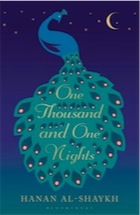
One Thousand and One Nights ~ Hanan Al-Shaykh

One Thousand and One Nights is Lebanese writer Hanan Al-Shaykh's re-imagining of nineteen stories from the Arabian Nights (as they tend to be known in the west). Al'Shaykh's prose is seamless and beguiling and it's hard not to feel that, like King Shahrayar, the reader is in the process of being bewitched by a master story-teller. Al-Shaykh believes that Shahrazad's  weapon is 'art at its best' and she admires the simplicity of the language of the original stories, noting that it is 'the language of those who didn't reach for a dictionary but expressed their true, crude, raw and intense feelings.' Al-Shaykh's re-imagining is written in deceptively simple prose. The reader is eased into a series of beautifully written stories that loop and sweep into each other as the book unfurls like a collection of Russian dolls. Some of these stories, such as The Fisherman and the Jinni' are humourous; others, like 'The First Dervish' are violent; many of the stories are erotic, brutal and poetic, and the book itself is an object of beauty that puts ebooks to shame.

Read the Forward here.
Read a review here.
Read an interview with Hanan Al-Shaykh here.

Thursday, 12 April 2012

Dancing in the Asylum ~ Fred Johnston

Dancing in the Asylum has been described as 'an unexpected portrait of a place and its people in a time of great change.' In the title story an alcoholic named Pritchard wakes up in hospital after a bender. Pritchard is spectacularly deluded and selfish, and the story explores his dawning awareness of the circumstances which led up to his hospitalisation: 'There were things groping and crawling their slimey way up from his memory that he did not want emerging into the light.' In 'Ship of Fools' a young refugee tells his story with 'the strained rhythm of a recitation... a story whose truth was hidden under too many applied coats of panic and loss.' When refugees try to become a part of the community they discover that acceptance is 'not a song you [can] sing or imitate' because no outsider knows the 'music of the village.' While the villagers make a show of welcoming the young man in front of the tourists, seeming to say through him, 'look how colourful and rich is our understanding of the world,' their acceptance is superficial and tragedy lurks around the corner. The stories in this collection are carefully observed, skillfully executed studies of loneliness and isolation.

Read Fred Johnston's blog here.
Read an interview with Fred Johnston here.

Wednesday, 11 April 2012

Married Love ~ Tessa Hadley

In this elegantly written collection Tessa Hadley presents twelve stories about family relationships. In the title story nineteen year old Lottie marries university lecturer Edgar Lennox. Hadley deftly sketches the reactions of each family member with Noah, Lottie's brother, offering perhaps the most concise, yet alarming observation: 'He knew how passionately she succumbed to the roles she dreamed up for herself. She won't be able to get out of this one, he thought. She can't stop now.' And indeed, Lottie doesn't stop. She produces three daughters in quick succession, confessesing in the final scene of the story, 'I'm grey... My life's so grey.' Hadley's short stories read like miniature novels; her characters are vividly drawn, their experiences compelling, their humanity familiar. My favourite story is 'Friendly Fire' in which Pam and Shelley do a 'scrub-off' clean at an industrial warehouse. Pam is a woman who always drives with the interior light on, she treats her car 'just like another room in the house' and she is 'fat like a limp saggy cushion.' Shelley's son is in Afghanistan and she finds that she is 'always waiting for some dreadful kind of message.' Hadley explores friendship and family in this tender and funny story.

Read reviews here and here.
Read an interview with Tessa Hadley here.

Tuesday, 10 April 2012

A Pitying of Doves ~ Felicity McCall


A Pitying of DovesThis collection of linked stories is set in South Armagh. McCall has said that while the collection is fiction, it also contains an 'element of memoir.' The first story, 'The Cardinal Conway Essay Prize' explores themes of belonging, alienation and loss of innocence as Evie discovers that despite her excellent prose, she is 'the wrong writer.' In 'A Mother's Love' people speculate about Mary's past, but she has 'perfected the art of anonymity.' McCall takes the reader back into the past to see and understand the reasons for Mary's reticence. The title story explores the 'deconstruction and disposal of the trappings of a life' as Evie watches her mother come to terms with her father's death. McCall writes with a quiet dignity and a keen eye for detail in a collection that has been described as 'refreshingly dispassionate and coolly humane.'

Read an article about the book here.
Visit McCall's website here.

Friday, 6 April 2012

Quiet Houses ~ Simon Kurt Unsworth

'Quiet Houses' is a collection of linked ghost stories. At the conclusion of the collection investigator Nakata maintains, 'I have tried to show that there are places we can't yet understand, that there are places where the quietness lets some of us experience things differently.' The fact that many of the stories in this collection are quiet (think measured, restrained) doesn't impede upon their power to chill and horrify. In 'The Elms, Morecambe' widower Wisher is haunted by the ghost of a girl who makes everything cold and miserable. 'The Merry House, Scale Hall' is a frightening, epistolary story that offers a horrifying explanation for the disappearance of fourteen local children. In 'Beyond St. Patrick's Chapel , Heysham Head' Nakata is chased by underground trails which move like worms 'burrowing through the dirt just below the surface of the earth... questing ceaselessly onwards.' This collection has been described as 'quietly impressive, quietly ambitious and loudly terrifying.'

Read 'The Elms, Morecambe' here.
Read Unsworth's blog here.
Read a review of 'Quiet Houses' here.

Thursday, 5 April 2012

Somewhere in Minnesota ~ Orfhlaith Foyle

somewhere in MinnesotaFoyle's work has been described as 'compelling and memorable.' This collection is littered with flawed characters, secrets and violence. In the title story Frankie doesn't appear to want love - her partner Peter thinks that perhaps she just isn't 'built for it.' Unable to find happiness in the present, Frankie looks back with a kind of nostalgia to the moments after her father last hit her: 'He stood back and waited a few seconds before he fixed my hair behind my ears.' The story is shocking and sad. 'The secret life of Madame Defarge' is a beautifully written exploration of violence, as is 'Two Vampires,' a horror story which starts like a joke: 'Two Vampires cross the road, enter a cafe and order eggs.' The reader is hoping for a less violent end in 'Sweet Frankie' however, the adults in the story appear to be helpless to prevent it. The collection concludes on a redemptive note in 'The Kiss' as Dennis looks at Ruth's black and green bruises: 'I smelled the medicine from the bandages,' he says, 'and I just kissed her.'

Read 'The Secret Life of Madame Defarge' here.
Read Orfhlaith Foyle's blog here.
Read an interview with Foyle here.
Read a review here.

Wednesday, 4 April 2012

A Book of Blues ~ Courttia Newland


A Book of Blues is a collection of thirteen contemporary stories, 'threaded with the constant pulse of music.' The first story, 'Beach Boy' explores ethnic tensions and stereotypes in Lamu. Palermo is frustrated when the local young men call him mzungu, Swahili for white man: 'to hear it referred to him meant they knew where he came from but didn't give a damn about heritage and culture and roots, or any of the things he'd been writing about for ten years, possibly more.' The local young men are intimidating and hostile, and the reader becomes increasingly anxious for Palermo's safety as the story progresses, but the final scene is one of contrast rather than conflict. In other stories, a young mother in 'All Woman' practically sings the reader through prose that is written in a dialect so precise and musical, it can almost be heard. In 'Spider Man' jealousy sneaks up 'like a jewel thief' to wreak a relationship and in 'White Goods' a spider tattoo itches when the narrator is about to come into luck. Never predictable, fresh and entertaining, A Book of Blues is a cracking collection.

Read Courttia Newland's blog.
Read an interview with Courttia Newland here.
Read a review of A Book of Blues here.

Tuesday, 3 April 2012

Dogsbodies and Scumsters ~ Alan McCormick

Dogsbodies and ScumstersThese stories have been described as 'chillingly understated, delicate and disturbingly hilarious.' The collection opens with 'Deal or No Deal,' the sad and funny story of Brenda who is 'her own worst enemy.' In this story and many of the others in Dogsbodies and Scumsters, McCormick demonstrates his skill at laying bare the internal logic of damaged minds. 'Real Mummy' is a chilling story of criminal incompetence, while 'Mad Mike' has echoes of Jekyll and Hyde. There is some lovely language in this collection; in 'Reasons to Swim Inside the Sky' canals are described as 'mustard smelling trenches of blink-and-you-miss-it spam splatters of colour.' The book is complemented by Jonny Voss's extraordinary illustrations.

Read stories and enjoy the illustrations here.
Read an interview with Alan McCormick here.

Monday, 2 April 2012

Ten Stories About Smoking ~ Stuart Evers

Ten Stories About SmokingTen Stories About Smoking is an accomplished collection; it's a collection that allows its reader to relax, confident in the knowledge that each story will be a satisfying experience. Evers concentrates on moments of realisation and disappointments that are at once small and shattering. There is a pervasive sense of nostalgia, both for a time when it was easier to smoke and for a time before isolation and unfulfilled ambitions changed the landscape of the  characters' lives. My favourite story is 'Things Seem So Far Away, Here,' in which Linda visits her successful brother and fantasises about leaving her own life behind. The dialogue is spare and incisive, and the relationship between Linda and her niece Poppy is beautifully observed. As I approached the end of the story, I sensed what was coming and even though it is quite devastating, it is perfect.

Read a review here.  
Read an interview with Evers here.
Read Evers's blog here.

Sunday, 1 April 2012

12 Days of Winter: Crime at Christmas ~ Stuart MacBride

Twelve Days of Winter: Crime at Christmas (short stories)This ebook collection of linked short stories playfully follows the pattern of the well-known Christmas carol. The first story is called, 'A Partridge in a Pear Tree,' the second, 'Turtle Doves' and so on. Despite this playful structure, the stories are violent and macabre. In 'A Partridge in a Pear Tree,' fat Billy Partridge - desperate for 'a joint and a packet of Jaffa Cakes' - has to steal Monet's 'The Pear Tree' in order to pay a debt. In 'French Hens' a restaurant owner finds a novel way to deal with a critic and in 'Calling Birds' Tracy makes an unwelcome discovery while she operates the 'Sexy Sadie' phone line. 'Geese a Laying' sees prison guard Val take extreme steps to have a baby and in 'Drummers Drumming' PC Richardson's dangerous plans go awry. Although many of the stories are gruesome, most are simultaneously funny; think Hot Fuzz in North East Scotland.

Visit Stuart MacBride's website here.
Read an interview with Stuart MacBride here.