

Tuesday, 25 September 2012
Joanna Ezekiel ~ My Delayed Reactions


Monday, 24 September 2012
Collecting Stories
 I have a brief article about putting together a short story collection over at Lancashire Writing Hub. I talk about how I selected the stories for Sweet Home, how I ordered them and how I chose the title.
 The picture to the left is my kitchen worktop. I used post-it notes to help me order the collection and I swapped the stories around as I passed. To read more about the process click on the above link.
Saturday, 22 September 2012
Sweet Home Launch

I'm having my book launch at Broadhursts a beautiful, independent bookshop in Southport (see photograph).
I'm really excited (and horribly nervous) about introducing Sweet Home to people on 9th November at 5:30 pm.
Friday, 7 September 2012
'Into the Penny Arcade' and 'Marionettes'
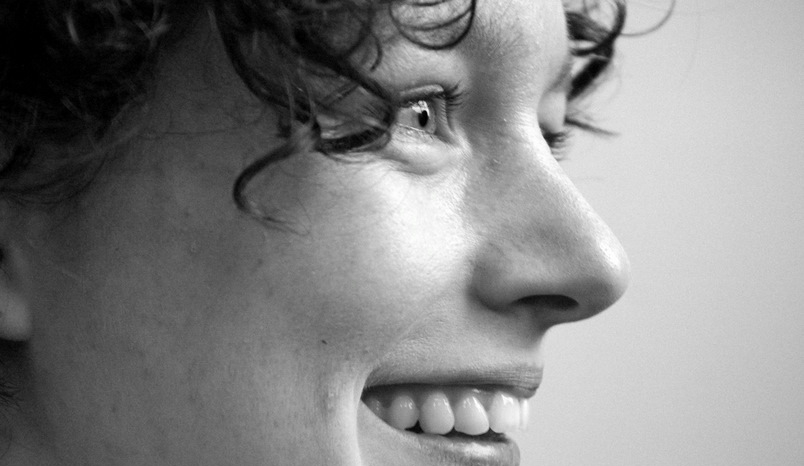 Back in March I bought two limited-edition, Nightjar Press chapbooks by Claire Massey and I finally read them this week.
I love Claire's writing, particularly her magical and melancholy Feather Girls. In these new stories she continues to explore transformation, but 'Marionettes' and 'Into the Penny Arcade' are darker and altogether more sinister than 'Feather Girls.'
 A bullied school girl seeks refuge in the back of a highly suspect lorry in the tense and disquieting 'Into the Penny Arcade.' I was on tenterhooks from the moment the back doors of the lorry opened and the girl stepped inside.
The lorry is full of old fashioned arcade games. There is something inherently sinister about these old-fashioned, machines and when the man in the back of the lorry refuses to let the girl leave until she has played several games, the reader experiences a horrible and rapidly escalating fear that the stakes may be much higher than the girl realizes.
The genius of this story is the way in which the readers' fears are repeatedly misdirected. There are moments of, 'Phew!' immediately followed by, 'No, no, don't do that!' and the ending manages to be both terrifying and satisfying.
 'Marionettes' takes place in Prague. A pale-faced couple with 'dispirited eyes' are revisiting the city seven years after their first holiday there. The couple have since had two children and their relationship appears to be in trouble.
While the husband, Karl, is hungover, the unnamed wife wanders around the city alone. She finds a marionette shop and is surprised to see only two marionettes in the window, exact copies of herself and Karl.
Back at the hotel, she tells Karl about the shop. He says she is being 'ridiculous' and they set out together to find the shop. When they can't find it, the wife says, 'Come on, I give up.' There is a sense that she isn't just giving up on finding the shop and, as the story develops, this act of giving up takes on a disturbing significance.
Anyone who has visited Prague will remember the cobbled streets and puppet shops which Massey utilizes so well in this story. Of the two stories, 'Marionettes' is probably my favourite. While 'Into the Penny Arcade' is tense and absorbing, 'Marionettes' is ultimately the more chilling story because it is so coolly and dispassionately executed.
Both limited-edition, signed chapbooks are still available for £3.50 each and can be purchased online at Nightjar.
Photo of Claire Massey by Jonathan Bean.
Sunday, 2 September 2012
Interview with Zoe Lambert
 I recently interviewed short story writer Zoe Lambert. Zoe's debut collection The War Tour was shortlisted for the 2012 Edge Hill Prize. The War Tour has been described as 'disarmingly plain and to-the-point... a kind of narrative ambush' (The Guardian) and 'A startlingly good collection of stories' (Mslexia).
I will be looking at The War Tour with first year students in the coming weeks and I hope Zoe's candid and detailed responses to the questions below will add something to the discussion of her quietly devastating stories.
Congratulations on the
publication of The War Tour and your shortlisting for the Edge Hill
Prize. How long did it take for you to write the stories in this collection?
It was
written in stages. The book began with ‘These Are Only Words’ and The Breakfast
She Had’, which I published in a short story cycle in 2005. Then I was trying
to finish a PhD for years, which some more of the stories ended up being a part
of. But I wrote the majority of the book post PhD in 2010. It’s the kind of book
I couldn’t write overnight; it needed time to develop and mature.
It’s annoying to be asked if
stories are autobiographical (so I’m not going to do it) but when I was
reading the collection I felt as if there might be a lot of ‘you’ in the title
story. Is this true and do you share some of James's reservations about tourism
and war?

There’s
actually a lot of ‘me’ permeated through some of the stories, or at least
certain feelings and emotions, even in the characters that aren’t young and
female. Of course, the relation of the self to writing is more complex than the
insertion of autobiographical experiences or facts or the creation of characters
of the same age and gender as the author. For example, while I was writing the
book I was for various reasons feeling pretty trapped and frustrated with my
life. I was unhappy and anxious most of the time, and filled with an often overwhelming
sense of fear. Looking back, I think those feelings are present in a number of the
stories, even though of course, my feelings had nothing to do with the enormity
of what the characters were going through. It’s probably obvious The War Tour
wasn’t written by a very happy person, and more importantly, one who wasn’t
very happy with the world. But admitting this doesn’t really add anything to
readers’ understanding of the book. So what if I was a bit miserable? It’s
funny that talking about autobiography is the first thing you’re told not to do
when studying literature, but we are all obsessed with it. Sometimes I wish
people would remember, ‘The Death of the Author’. Please, please kill me off
and think about the writing in its own terms.
I love the variety in The War
Tour. I imagine that ‘The Spartacist League’ (one of my favourite stories)
required a lot of historical research, whereas other stories suggest a
familiarity with certain cities and countries. How did you approach the
research for the collection?
I’m glad
you like that story. The research was a mix of the experienced, of travel, of
engagement with issues and with bookish research. I list some of the books in
the 3am interview (insert link). Mostly, the point of my research was to try to
understand the personal experiences of certain conflicts rather than the
macro-politics. How did people end up doing what they do? How has it affected them?
How do they live with it? Though I also did a lot of research into the
backgrounds of conflicts. I tried to go beyond mainstream media, and to look
into alternative media and histories; it’s probably evident I’ve taken a
Chomsky-esque approach to issues of foreign policy. I used my university
library access to read academic political journals. I was looking for the
untold stories, the stories that countered the tabloid media representations of
recent and past wars; the details that contradicted my assumptions about the
world. Many recent conflicts have their roots in European colonial legacy, so I
researched into that and I tried to draw some of the stories back to that
(again, see ‘Notes’). I tried to be aware of where I was writing from, and my
own position in history. But can you ever write outside of your own political
moment? The book could never be the ideal book I wanted it to be; it was
destined to be a failed project.
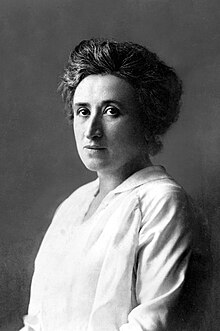
The crux
of the story though is based on what we don’t know about her death. The
triangular relationship I set up in the story comes from Mathilde Jacob’s
biography, but no one knows who told the authorities about where she was
hiding. So what we don’t know became an essential ingredient of the plot.
That’s where I messed with history. Without this being revealed there would be
no story, just a sequence of events (to quote E M Forster) leading up to her
death (as there was in an early draft). Also, because it’s a known fact that
she was assassinated, I ended it on her knowing she will die, of her having a
premonition of her death in a very self-consciously Spartacus moment (I am
Spartacus; I am Rosa Luxemburg). In many ways, with the repetition of language,
the ending of the story is very stylised.
I tried
to vary the shape and form of the stories, while keeping them realist. So this
story ended up not seeming like a short story; to me it feels more like a
novella. It was quite hard to keep the
stories as neat ‘stories’, or ones that focused on an epiphany or revelatory
moment. They had to be bigger, more expansive, cover longer periods of time:
all things people don’t think short stories should do. But I wasn’t trying to
write perfect short stories, I was trying to write half-decent stories about
war.
It seems to me that the
collection had to open and close with ‘These Words Are No More Than A
Story About A Woman On A Bus’ and ‘We’ll Meet Again.’ Did you always envisage
these stories as the opening and closing stories? Do you think order is
important in a collection and how did you decide on the order of the
stories?
Order is
very important in this book. ‘These Are only words’ sets up the reader as being
a listener to the stories, but it wasn’t written for that purpose; it just
happened to work and it was reprinted without change from Ellipsis 2. But I
wrote ‘We’ll Meet Again’ as the final story. I wanted a sense of quiet closure;
something meditative, of life going on. It is also set the night after the other
stories set in Manchester, so we see Japhet again on the tram heading off in a
moment of possibility.
For the
order, I had a sense of a day passing in the connected Manchester stories (From
Kandahar, Lebensborn, 33 Bullets, We’ll Meet Again). They were the framework of
the book, giving it a slight temporal arc. In between these I wanted some
stories to be read before others (for example, I wanted 33 Bullets to come
before When the Truck Came). I also wanted them to be varied in terms of place
and time. For the remaining stories I basically wrote the titles on pieces of
paper and played cards with them to work out the order.
Were there stories you had
originally written for The War Tour which ended up not being
included in the collection?
I spent
ages trying to write a ‘corridors of power’ story about Whitehall and Iraq. I
tried to write about that coldness that comes with bureaucracy, but I wasn’t
able to in the end. Maybe I’ll write it some day...
 You had editorial feedback from
Comma’s Ra Page. What’s it like to work with an editor? Were there times when
you disagreed?
You had editorial feedback from
Comma’s Ra Page. What’s it like to work with an editor? Were there times when
you disagreed?
When
you’re writing a book, it can be hard to see its outlines, especially a
collection of stories, in which there are so many disparate parts. But an
editor can see the outline because they are outside of it. I think Ra saw what
the book could become before I did and his feedback and editing was invaluable
(for example, he made some of the suggestions for the ending of Rosa’s story). We
certainly disagreed. With feedback, mostly what I’d do is take on board his suggestions
and think about them for a while and then come back to him or work on the
stories. It can also be tempting, especially if it’s your first book, to think,
The Editor Knows Best. But a good editor won’t want you to agree with
everything they say. Editing is a process and a dialogue.
Do you have a favourite story in
the collection? If you do, why is it your favourite?
I think
‘My Sangar’, only because it manages to do so much in 300 words. It has a
purity to it. It makes me wonder if I wasted lots of words in the other
stories: could they all be 300 words?
 Did you have any input in the
cover design? Is it what you hoped for/envisaged?
Did you have any input in the
cover design? Is it what you hoped for/envisaged?
The cover
is made up of my passport stamps, my dad’s and my friend who is Ugandan. So I
collected the passports and the designer used them to make the cover. The
background is the inside of a Ugandan passport. I like it because it highlights
the idea of borders, border control and immigration that are so important to
the book.
What are you working on now?
A new
book. Its narrative shape and form keeps changing. It draws upon my own
experiences of disability and caring, which I began to write about in my
Ellipsis 2 stories. I’m developing those themes and bringing in more about the cuts
and changes to welfare happening at the moment, but I want to juxtapose this
domestic story with a genre narrative, bit like in Margaret Atwood’s Bodily
Harm. At the moment I’m not feeling very confident about it and hating
everything I write. But I know what I want it to be, what I want it to do. It
will be a lot funnier than The War Tour... I hope....
Where do you like to write?
In bed.
In cafes. In libraries. In pubs. Anywhere but at my desk. I don’t know why. I
think these other places enable me to escape my own thoughts, but at a desk I
can’t.
In an interview with 3am
Magazine, you say, ‘a friend told me to just keep writing instead of trying to
plan everything in advance; the links and form would emerge through the writing
process.’ I can see how this advice would be very freeing as you worked on the
stories in The War Tour and I’m interested to know whether you continue
to keep writing instead of trying to plan everything in advance in your
present work.
I’m quite
an abstract writer; I know what I want to achieve with a story, or the idea
behind it, and sometimes the feeling, but HOW I will get there isn’t so planned
and I usually have to find this out in the writing process. What didn’t work
was trying to impose a form or structure on the stories beforehand, or
repeating a structure. At one point I tried to make some of the stories very
postmodern and knowing, but I got rid of that. It felt trite.
With my
new work, I have a strong idea of what my book is about. But as I said the
structure and form of it keeps changing. How I will get there is still a
mystery. And that is scary.
Friday, 24 August 2012
Sweet Home Cover
I trudged through my twenties on auto-pilot. In my mid thirties I suddenly woke up and remembered there were things I'd always wanted to do. I decided to go back to university. I was a 'mature' student. I was tired and pessimistic. I'd had a difficult few years and I was scared that I'd left it too late. I had four small children and it was hard work trying to juggle everything, but it was also wonderful and exciting and inspiring.
 During the final year of my degree I asked Rob Mimpriss to recommend some short story collections. He recommended several, including Carol Shields' Dressing Up For the Carnival. I liked her writing so much that I went away and bought the rest of her short stories, along with Mary Swann, The Stone Diaries and Unless. The Stone Diaries in particular was a revelation to me; I enjoyed the first chapter so much, I read it twice before moving on to chapter 2 - the only time I've ever done that.
 I decided I would write to Carol Shields to tell her how much I loved her work. I looked her up online and made the sad discovery that she had been dead for five years. Instead of writing to Carol Shields, I ordered all of her books and I read about her life. Shields had five children. When she first started writing she could only spare an hour a day. Reading this made me realise I could also find time to write. And, after a while, I began to think that maybe, if I worked hard enough, and if I was lucky enough, I might be a writer too.
I finished my BA and I started an MA. In the coffee break during my first MA seminar I felt so nervous/terrified/inadequate that I retreated to the toilets and almost talked myself out of doing the course. But I finished the MA and kept writing. A year later I sent off a manuscript containing my MA stories and several new stories. I held my breath and crossed my fingers. I alternately hoped and convinced myself that it would never happen. But it did, and I couldn't believe it. It didn't seem real. Until today.
Here's my book.

 During the final year of my degree I asked Rob Mimpriss to recommend some short story collections. He recommended several, including Carol Shields' Dressing Up For the Carnival. I liked her writing so much that I went away and bought the rest of her short stories, along with Mary Swann, The Stone Diaries and Unless. The Stone Diaries in particular was a revelation to me; I enjoyed the first chapter so much, I read it twice before moving on to chapter 2 - the only time I've ever done that.
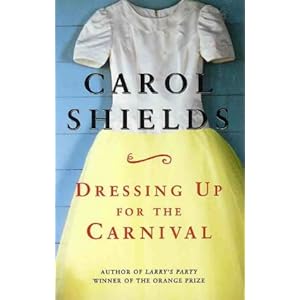 I decided I would write to Carol Shields to tell her how much I loved her work. I looked her up online and made the sad discovery that she had been dead for five years. Instead of writing to Carol Shields, I ordered all of her books and I read about her life. Shields had five children. When she first started writing she could only spare an hour a day. Reading this made me realise I could also find time to write. And, after a while, I began to think that maybe, if I worked hard enough, and if I was lucky enough, I might be a writer too.
I finished my BA and I started an MA. In the coffee break during my first MA seminar I felt so nervous/terrified/inadequate that I retreated to the toilets and almost talked myself out of doing the course. But I finished the MA and kept writing. A year later I sent off a manuscript containing my MA stories and several new stories. I held my breath and crossed my fingers. I alternately hoped and convinced myself that it would never happen. But it did, and I couldn't believe it. It didn't seem real. Until today.
Here's my book.

Thursday, 23 August 2012
Judging my book by its cover

It's very exciting to look at cover options for my short story collection. It makes the whole publication process seem real somehow.
The lovely people at Salt Publishing have produced the gorgeous options pictured. I love the doll's foot image. I think it's striking and disquieting. I just can't quite make up my mind which colours I like best. Hmm...
Tuesday, 7 August 2012
Holiday Reading
 I wish the weather would improve so that I could banish the kids to the
garden and do the whole, 'Get some fresh air,' routine that I remember
my parents doing during the school holidays. I had visions of reading in the garden, but every time I go out there I seem to be rescuing washing from thunder storms. I've got three piles of books to read.The pile on the right is teaching preparation.
I wish the weather would improve so that I could banish the kids to the
garden and do the whole, 'Get some fresh air,' routine that I remember
my parents doing during the school holidays. I had visions of reading in the garden, but every time I go out there I seem to be rescuing washing from thunder storms. I've got three piles of books to read.The pile on the right is teaching preparation. 
This pile is a research/PhD pile. I'm particularly enjoying Still, the Small Voice which analyses Mormon narratives involving encounters with the supernatural. I grew up listening to these kinds of narratives so I'm finding Tom Mould's ethnographic interpretation of Mormon culture and belief absolutely fascinating.

Here's my holiday dose of 'feminist commonsense' (Guardian on The Equality Illusion) and 'a vitriolic attack on sexism masquerading as psychology' (Evening Standard on Delusions of Gender).

Once I've finished these books, I'm going to read Alison Moore's The Lighthouse which has been longlisted for the Man Booker Prize.
The Lighthouse has been reviewed in the Telegraph and here is a free extract from the book. Many congratulations to Alison, and to Chris and Jen at Salt Publishing.
Tuesday, 31 July 2012
Insignificant Gestures ~ Jo Cannon
The best thing about helping with the Edge Hill Prize was discovering brilliant writers, many of whom were published by small, independent publishers with little or no budget for publicity. One of my favourite longlisted collections was Jo Cannon's 'Insignificant Gestures.' I reviewed it in 2011 here, but I recently reread the collection and have written a longer review:
Jo Cannon is a GP in an inner city practice and her medical
expertise is brought to bear in many of the stories in this entertaining and
readable collection. Her writing is moving but decidedly unsentimental. The
collection begins quietly with the title story 'Insignificant Gestures.' The
doctor narrator has returned from Malawi and retrained as a psychiatrist so
that he will never have to 'smell blood again, or the sweet nail varnish odour
of starvation.' His experiences in Malawi have left him dependent on medication
that makes his fingers tremble, but he confesses that he would 'take anything
not to wake a three in the morning with my thoughts crawling round and round
like caterpillars along the rim of a glass, endlessly circling the same
regrets.' Some of those regrets are explored as the doctor remembers a fatal
misdiagnosis which left him unable to sleep and feeling 'all edge and scalded
surface.' In the closing scene the doctor's memories tumble out, 'like opening
an overhead locker.' As he talks about Malawi to a nurse he watches her chewing
on her thumb and notes, 'Beginnings start like this, with insignificant gestures.'
It's a carefully observed, restrained story that explores degrees of helplessness
and sets the tone for the rest of the collection: watch out for the details in
these stories, observe the minutiae, the seemingly insignificant gestures, this
opening story seems to say.
Medics appear in many of the stories. A doctor’s tact and
kindness lead to a moment of acceptance in the sad and funny ‘New Look.’ In ‘Rictus’
a bereaved woman is assailed by memories of medical interactions after her dog
dies, while a nurse’s recommendation of speed dating in ‘The Alphabet Diet’ allows
Mick to finally acknowledge, ‘how hard it is to tell the truth, to open drawers
and show the broken things inside.’
One measure of a successful collection is the memorability of the stories; how many of them stick with the reader and niggle long after the book's pages are closed? 'Insignificant Gestures' is packed with stories that resonate. ‘Fairy Story’ examines a mother’s feelings of culpability when
her daughter is hospitalised for anorexia, but it’s not a story without hope. ‘There’s
always a way back,’ she tells her daughter. ‘The good and courageous will
prevail. And if you are lost, sooner or later someone you love will come and
find you.’ 'Daddy's Girl', a story in which a young man boards the tube
carrying a rucksack, is an intricate exploration of secret thoughts and
isolation. Jo Cannon achieves a lot in very few words and the story ends with a revelation of what is to come: ‘A little girl won’t go to school. Police
cars and TV crews will come in the night. Her friend’s fear will be the first
crack. Aftershocks from the explosion will injure all the days of her life.’ In 'Mercy is Sick Today' a girl embraces her prodigal sister:
'Flicking at flies, shooing curious children, I guard her. At midday I light
the fire for nsima. Not everyone in the village will eat today.'
Other particularly memorable stories include the sinister 'Shutters' in which the narrator says to his
wife, 'Now you're ill it's better. There's only me.' 'A Good Match' is an intricate examination of cultural differences in an arranged marriage, while Dr Campbell is visited by a ghost from her past in 'The Spaces Between' and in 'Staying Power' a woman takes a stand: 'I tear him out like wrapping paper: pinch the edges and pull. So easy I could have done it any time.'
Zoe King maintains that to read Jo Cannon is to 'enter the world of the displaced, the dispossessed, and to emerge with a new understanding,' and Vanessa Gebbie writes that 'Insignificant Gestures' is full of stories that 'sing long after the reader has put down the work.' I felt sad when I reached the end of this collection because I wanted to keep reading. If Jo Cannon produces another collection it will go straight on my wishlist.
Wednesday, 18 July 2012
Word Theatre
 Here is a picture of actor Jane Zingale of WordTheatre performing one of my stories, 'My Burglar' at the Latitude Festival.
I really, really wanted to go, but it just wasn't possible in the end. One of the children has been in hospital and there has been so much to do.
Unfortunately, there was a technical problem with the recording of the event, so I won't be able to hear the performance, but I've heard from a friend who was there that it was very good. It must be really exciting to listen to an actor read your words and, if such a thing ever happens again, I will (temporarily) run away from home to watch the performance.
Subscribe to:
Posts (Atom)