
I'm really not sure what to read for this one. I've got a feeling it's going come down to a last minute decision on the day. Something funny or something serious? Something from the collection or something from the novel? Hmm...


 Tucked up on the ward and secure in the latest technology, Zelda is about to give birth to her baby. But things don’t go to plan, and as her labour progresses and the drugs take over, Zelda enters a surreal world. Here, past and present become confused and blend with fairytale and myth. Old secrets surface and finally give birth to disturbing revelations in the present.
 'ween the reader (and in particular the unwilling or squeamish reader) gradually from the safety of 'objectivity,' via a growing familiarity with Zelda through her memories, to the shock of her subjectivity - though even then her experience is presented as flashback, in third-person past tense: Zelda herself, leave alone the reader, can only contemplate it at a distance.'
'Good morning Mrs Harris. Mrs Harris is about to benefit from our modern technology. Aren't we, Mrs Harris?' He says with a wink in Mrs Harris's direction: 'Mrs Harris is a rather special patient. How are we feeling, Mrs Harris?'The Professor's words set the tone for Zelda's interactions with medical staff throughout the novel. She is repeatedly patronised: ‘Naughty girl, now, Mrs Harris,’ 'Mrs Harris! What on earth are you doing out of bed,' 'How are we doing Mrs Harris?' The reader initially sees Zelda through the eyes of the Professor and his students. Baines writes that 'the whole is undercut by satire, and a questioning of the authority of the professor [is] thus prompted.' While this is certainly the case, the medical professionals also make the hospital scenes confining and distressing as their powerful, infantilising voices serve to propel Zelda again and again into childhood memories. The dream-like quality of these and other memories blend with myth and fairy-tale to further distance the reader and evoke feelings of powerlessness and disorientation.
 Congratulations to the Edge Hill Prize shortlisted authors:
‘Since developing the Scott Prize to promote and support debut short story writers, I have read and selected winners from hundreds of manuscripts. This year my task was made particularly difficult by the astonishing level of skill within our shortlist and I would recommend everyone to spend time discovering those writers. Making selections from the shortlist has been difficult but I have focused on the books which I believe have a depth and maturity of talent that all readers will immediately recognise. Carys Bray and Rob Roensch combine impeccable craft with unforgettable imagery to create stories that are surprising, psychologically resonant, emotionally complex and, above all else, a sheer joy to read. Carys and Rob, on either side of the Atlantic, both demonstrate that the short story is thriving and developing in the 21st century and I look forward to working with the writers and publishing their books later this year.’Last night I celebrated by eating half a tub of Haagen Dazs and having a bath. Now that the news is beginning to sink in, I think I'm going to have to find a better way to celebrate...
 So, after a month spent reviewing of Edge Hill Prize longlisted collections (there are thirty one this year) I am finally blogging about online friend Nik Perring's new release. I'm somewhat late to this party and there's probably no nibbles left, but at least I'm here.
.jpg)
 Chameleon is a lovely collection of beautifully written, sad and funny stories. The opening story 'Haunted' is an authentically imagined story about friendship. Ten year old Kirsty's jealousy is palpable and it leads her to do something terrible. 'The Quiet Man' is a satisfyingly wicked look at hidden depths and the resentment that builds when a new wife steals every moment of her husband's peace. In 'True Love' it is the old man Jim, and not the young narrator who understands what love is. 'Poor Clare' is an emotionally charged story about first love, transgression and the hope of absolution. There are supernatural and fairy tale elements in many of these satisfying and well-written stories. Beda Higgins's story 'Wiggy' won the 2009 Mslexia competition.
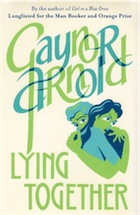 These short stories are so packed with life that each could easily stretch into a novel. Set during the Second World War, 'Looking for Leslie Howard' sees waitress Elsie discovering that a beautiful young man she admires is a conscientious objector. Arnold's writing is seamless and the characters are compelling: I would happily read the novel 'Looking for Leslie Howard' (if such a book existed). Each story in this collection is meticulously situated, from the modern day setting of 'Telling Radnor' to the reexamination of the past in 'Angel Child' the reader is instantly immersed in the beautifully constructed world of the story. The title story 'Lying Together' sees Glenys trying to get her 'thoughts straight through the mist' as she spends a fortnight with Bill. 'Taking People In' offers a glimpse into another world and the aforementioned 'Angel Child' contrasts beautifully with its predecessor 'Mouth.' The stories in this collection have been described as 'full of humanity but entirely without sentimentality.'
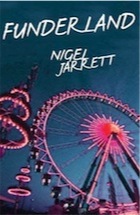 The title story of this collection is not for anyone who is nervous at the fairground. 'Funderland' sees Dale recalling a roller coaster accident with devastating clarity. He remembers how the car 'became wedged, somehow pinned by gravity into a corner from where he could see Johnny and Rose plummeting like rag dolls to their deaths.' It's a striking opening to a sensitive and revealing collection. In 'A Point of Dishonour' the narrator visits a writer, Kramer, who has written a book about soldiers that were court-martialled and shot in the Great War. The narrator's grandfather features in the book and she brings with her a newspaper clipping that shows her grandfather in a new and disturbing light. It is a subtle story in which what isn't said is important. Kramer hands the newspaper clipping back and becomes kurt, '...as if I had deliberately tried to embarrass him, and he twice looked at his watch without saying anything about soon having to attend to something else.' In 'Ornithology' depression is linked to the disappearance of birds as a woman misses their 'madness in the air.' Jarrett's writing is varied and musical.
 Eisner's collection is subtitled, Hidden Lives of Love, Madness, Murder, Loss and Deception, and while the sense of madness and loss is amplified by the book's extraordinary and disturbing cover, there is also a tremendous sense of fun here. Eisner makes use of intriguing subheadings and 'source material' such as newspaper clippings, graphs, poetry, diary pages and extracts from old school books. There are just five stories in this 228 page collection and these are followed by a series of graphological notes on the handwriting of various characters. 'Lovesong in Invisible Ink' is a digressive and knowing narrative that spans decades. The narrator is self-deprecating and likable; there's no Reader, I married him here, it's 'reader, I slept with him.' The title story is the last testament of its asexual narrator. It's a odd story, full of strange characters and erotic imagery: the narrator's husband refers to her as his 'long noodle,' and poor Uncle Irving's body has to be identified by dental records - all that is left of him is his toupee. The stories in this collection are dark and the characters are 'driven by bizarre and sometimes criminal compulsions.'
